
Courier Aggregator vs Single Courier: Which Is Better for Small Sellers?
20 August 2026 · 8 min read · by Courier Uncle team
If you’ve just started selling online, this decision usually shows up in the first month: do you stick with the one courier you signed up with, or move to a platform that gives you a few different courier options to choose from?
It sounds like a small decision, but it quietly shapes your shipping cost, your delivery reliability, and how much manual work falls on you every single day. Here’s an honest breakdown of both, so you can pick based on where your business actually is right now — not just what sounds better on paper.
What’s the actual difference?
A single courier setup means you sign up directly with one delivery company — say, a regional courier or one of the big national names — and every order you ship goes through them, at whatever rate and service level they offer.
A courier aggregator is a platform that partners with multiple courier companies (sometimes 10, 15, or more) plus often runs its own delivery fleet, and lets you book each shipment through whichever partner works best for that specific order — based on cost, speed, or coverage for that pincode.
Both approaches work. The right one depends on your order volume, how spread out your delivery locations are, and how much time you can spend managing shipping day to day.
Why most small sellers start with a single courier
There’s a good reason almost every new seller starts here — it’s simple. One sign-up, one login, one person to call if something goes wrong. When you’re shipping 5 or 10 orders a day, that simplicity is genuinely valuable, and there’s no need to overcomplicate it.
The problems usually don’t show up on day one. They show up a few months in, once order volume grows, delivery locations spread out beyond your courier’s strong zones, and the small cracks start costing real money.
Where a single courier starts to break down
- You have no comparison — whatever rate they quote is the rate you pay, even if a competitor would be 20% cheaper on that same route
- Coverage gaps — most couriers are strong in some regions and weak in others; if your buyer is in a pincode they don’t service well, delivery gets delayed or fails
- No backup — if that courier has an outage, a local strike, or a bad week in your area, every one of your shipments is affected, with no alternative
- RTO management is entirely on their terms — you can’t push for faster re-attempts or better handling, since you’re not a large enough account for them to prioritize
- Negotiating better rates takes real volume — most couriers won’t revisit your pricing until you’re shipping a lot more than you currently are
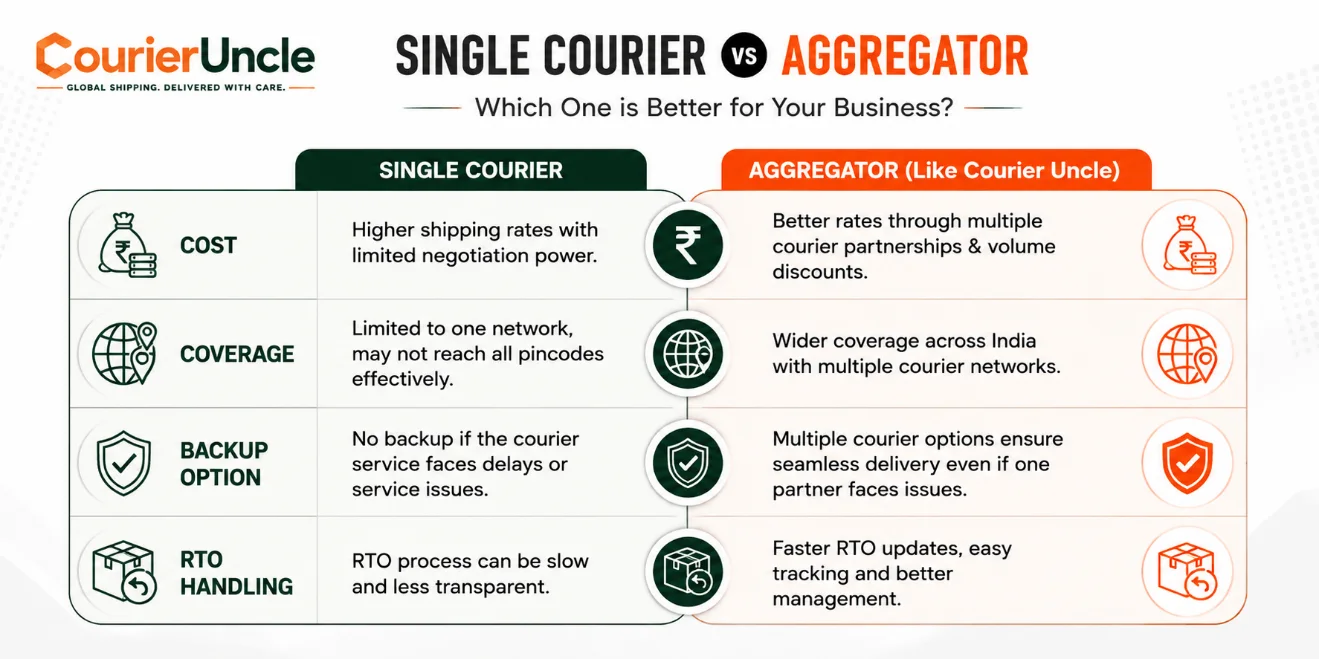
Single courier vs aggregator — side by side
| What matters | Single Courier | Courier Aggregator |
|---|---|---|
| Shipping cost | Fixed rate, no comparison — you pay whatever they quote | Rate compared per shipment across multiple couriers, usually 15–30% cheaper on average |
| Pincode coverage | Limited to that courier’s network — some areas may not be serviceable at all | Wider coverage since orders route to whichever partner covers that pincode |
| RTO / failed deliveries | You depend fully on their process; little control if it’s slow | Often has automated NDR re-attempt and RTO rules across partners |
| Onboarding effort | Simple — one sign-up, one contact | Slightly more setup, but still usually a single dashboard |
| Bargaining power | Low unless you ship in real volume | Higher — rates are pooled across many sellers on the platform |
| Tech / API access | Depends entirely on that one courier’s systems | Usually offers one unified API/dashboard across all partners |
| Backup option if courier fails | None — if they have an issue, your shipments are stuck | Orders can be re-routed to another partner |
This isn’t to say single couriers are bad — for very low, hyper-local volume, they can genuinely be the simpler and cheaper choice. The comparison above is about where each option tends to hold up as your business grows.
A real example: what changed after switching
A small home-decor seller in Jaipur started out shipping everything through one regional courier because it was the first one they found. For the first 3 months, with 15–20 orders a week, it worked fine.
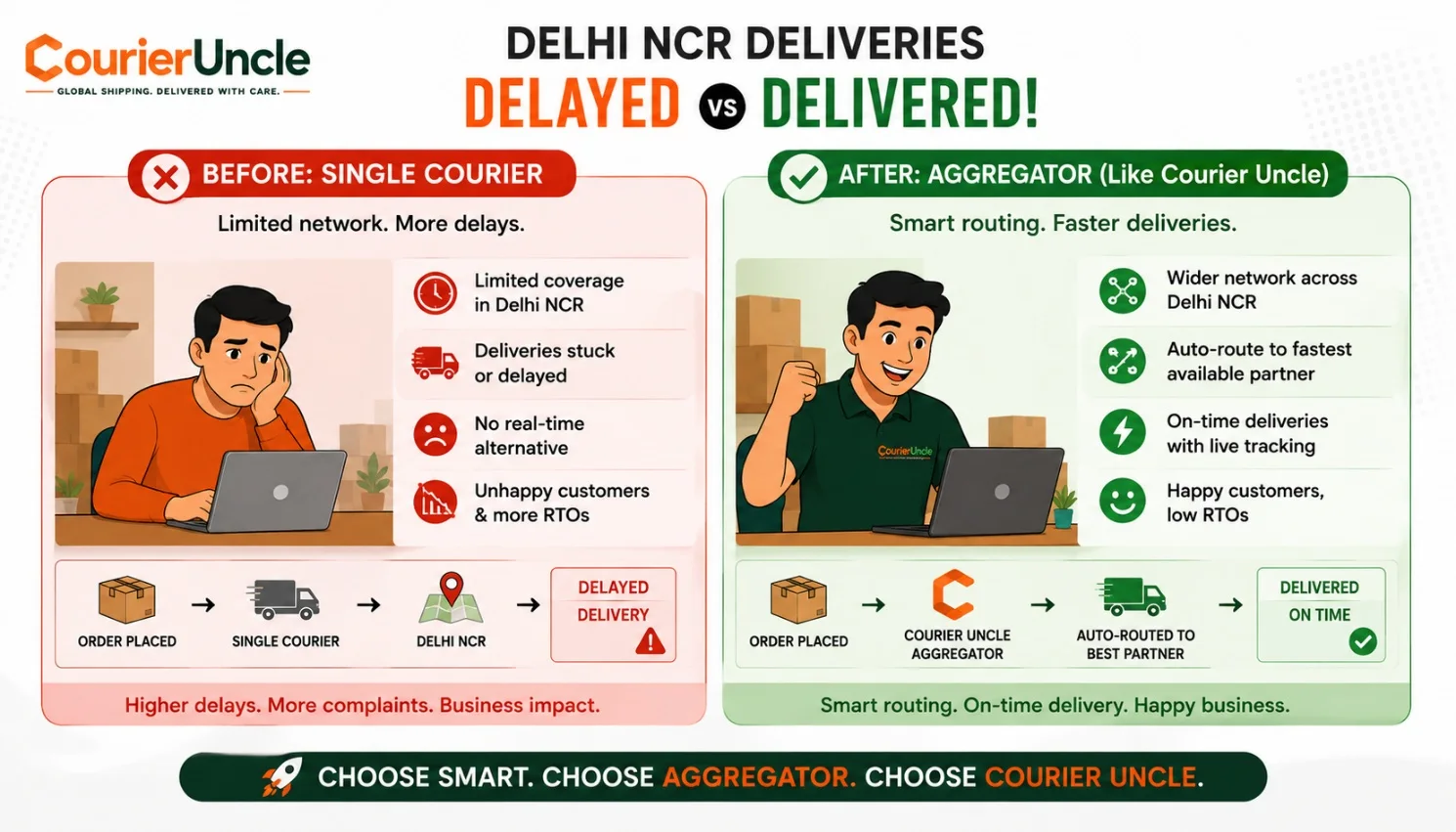
By month 5, orders had grown to 80–100 a week, and buyers were spread across Rajasthan, Gujarat and Delhi NCR. The single courier was reliable in Rajasthan but slow and inconsistent for Delhi NCR deliveries — leading to a string of delayed orders and a few upset customers.
After moving to an aggregator, orders to Delhi NCR automatically routed through a different, better-performing partner, while Rajasthan orders stayed on largely the same courier since it was already the cheapest and fastest option there. Nothing about the seller’s product changed — the shipping method simply matched the right courier to the right route.
When a single courier still makes sense
To be fair, an aggregator isn’t automatically the right call for every seller. A single courier can still be the better choice if:
- You ship very low volume (under 20–30 orders a month) from one location to a tightly clustered set of buyers nearby
- Your local courier already offers strong rates and near-perfect delivery in your exact area
- You genuinely don’t want to manage more than one relationship, and the extra cost is small enough not to matter yet
If any of this sounds like your situation, there’s no rush to switch. The moment it usually stops making sense is when your delivery locations start spreading out, or when RTO and delayed deliveries start happening often enough that you notice.
How to decide for your business
Choose a single courier if:
- Your order volume is small and steady
- Almost all your buyers are in one city or region
- You already have a reliable, fairly priced local courier
Choose an aggregator if:
- Your buyers are spread across multiple states or regions
- You’re shipping COD orders and want a predictable remittance schedule
- RTO or delayed deliveries are becoming a regular problem
- You want rate comparison without manually checking multiple courier sites every time
- You want one dashboard for tracking, labels, invoices and reports instead of juggling logins
This is usually where a platform like Courier Uncle fits in — it gives small sellers access to multiple courier partners plus an in-house last-mile fleet, all from one dashboard, without needing high volume to get decent rates. You get the simplicity of a single login, but with the coverage and backup of multiple couriers behind it.
Frequently asked questions
Is switching from a single courier to an aggregator complicated?
Not usually. Most aggregators are built to onboard sellers quickly — you sign up, add your pickup address and business details, and can start comparing rates within a day. You don’t need to close your existing courier account first; many sellers run both side by side during the transition.
Will I lose the personal relationship I have with my current courier?
No — most aggregators let you keep an existing courier as one of the partners in your panel if they’re already performing well for you. You’re not forced to drop anyone; you’re just adding options.
Do aggregators cost more because they add a platform fee?
Generally no. Most aggregators make their margin through pooled volume discounts from courier partners, not by charging sellers extra on top. Always confirm this directly, but it’s rarely a separate cost layered on your rate.
What if my order volume is too small for an aggregator to care about?
Aggregators are built specifically for sellers who don’t yet have the volume to negotiate directly with couriers — that pooled bargaining power is the whole point. Small volume is normal, not a barrier.
Can I switch back to a single courier later if I want to?
Yes. There’s usually no long-term lock-in with aggregators, so if your business genuinely simplifies down the line, going back to a single courier is always an option.
The bottom line
There’s no universally “better” option here — it depends on where your business is today. A single courier is simple and can work well at low volume in a tight geography. An aggregator earns its place the moment your orders spread out, your RTO starts creeping up, or you’re tired of accepting whatever rate one courier decides to quote you.
If you’re not sure which side of that line you’re on, the easiest way to check is to compare your current courier’s rates against a live aggregator quote for your actual routes — sign-up is free on courieruncle.com.
Ship smarter with Courier Uncle
Compare live rates across multiple couriers on your actual routes — sign-up is free, no volume commitment.
Compare rates free →